
Texas does not require a statewide general-contractor license, but owner-builder construction financing still requires a qualified builder structure, complete contract, budget, insurance, and controlled draws.
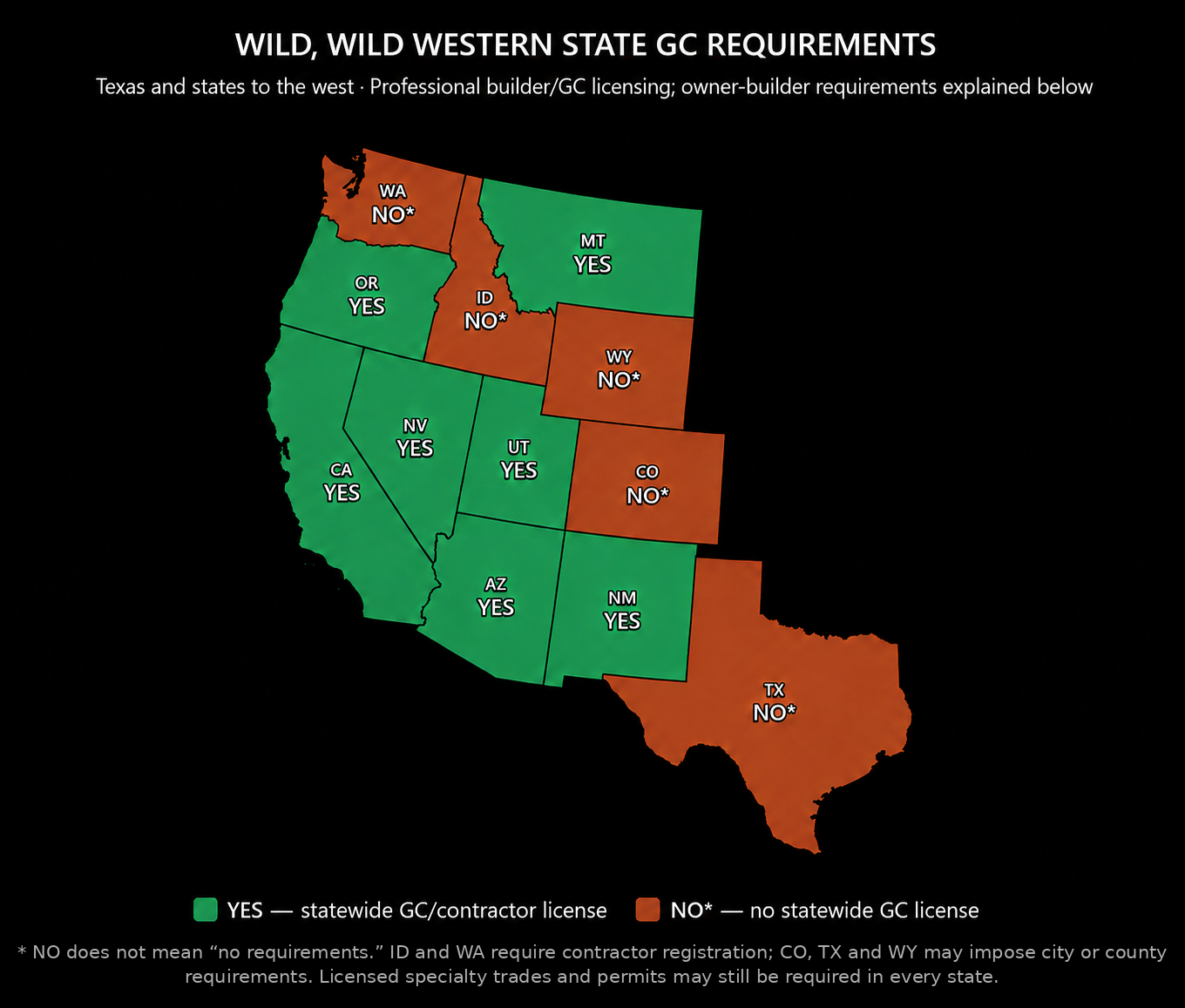
What Texas allows: no statewide GC license
Texas does not issue a statewide general-contractor license for general residential construction. Unlike states such as Arizona or California, a Texas residential GC does not have to obtain one statewide GC credential. That flexibility can appeal to experienced homeowners, construction professionals, and borrowers building through their own company. It does not mean there are no construction requirements.
Local rules vary by address. Austin, for example, registers general contractors and homeowners acting as contractors before they are assigned to building permits; Dallas uses its DallasNow registration and permitting process. A parcel outside city limits may have a different mix of county, floodplain, septic, utility, and other approvals. Ask the actual authority having jurisdiction rather than assuming a neighboring project followed the same rules.
- Local contractor registration, building permits, adopted codes, and inspections.
- Applicable liability insurance, floodplain, septic, well, driveway, fire-access, and utility approvals.
- HOA, deed-restriction, subdivision, energy-code, and licensed-trade requirements.
Specialty trades still require attention
Texas separately regulates electrical, plumbing, HVAC, and other specialty work. Non-exempt work generally requires appropriately licensed professionals, even when the owner is serving as GC. Some narrow homeowner exemptions or homestead permit processes may apply to particular work and jurisdictions; confirm them with the appropriate state and local authority, and do not assume a lender will accept owner-performed trade work.
An owner-builder needs an actual responsibility chart: who hires the trades, obtains permits, coordinates inspections and corrections, documents completion, collects lien releases, and covers delays or overruns? Those answers must also work with the lender's construction funding process.
Owner-builder permission is not lender approval
A homeowner may be allowed to hire trades directly, perform permitted portions of the work, or act as the project's GC. None of that establishes a financeable construction-loan structure. A lender must separately decide whether the borrower and the proposed builder arrangement meet that program's eligibility, contract, insurance, budget, and draw standards. Some lenders do not finance borrower-managed builds; others may review a borrower-owned construction company as the proposed builder.
Where a lender permits that structure, the company may need to qualify as the approved builder and enter into a formal construction agreement with the borrower, with one accountable party for the agreed full scope. Related-party terms and exact requirements are lender-specific. Do not assume Liberty Federal Credit Union accepts owner-builders or borrower-owned builders until its guidelines for the specific loan are confirmed in writing.
- Who is the approved builder under contract for the complete scope, and who manages the subcontractors?
- Who owns the line-item budget, schedule, permits, inspections, change orders, and insurance?
- Who requests draws, documents completed work, provides lien releases, and handles overruns or final completion?
Why the construction agreement matters
Construction funds are released in stages through the lender's approved draw process. The lender needs to understand who performs the work, what it costs, when it occurs, and how progress is documented. Draws commonly depend on verified progress and lender-approved documentation; some programs may separately allow specified material deposits or other advances under their own rules. A borrower's intention to complete work later is not, by itself, a draw milestone.
A management-only contract can leave the borrower with separate trade agreements while the manager merely coordinates them. That may not satisfy a lender requiring one approved builder accountable for the full scope. If each trade sends a separate bill, who verifies it against the budget, handles a failed inspection, funds an overrun, and completes the project if one contractor leaves? Unpaid work the borrower performs as an owner may be called sweat equity; work performed under an approved builder contract is professional contracting, even if the borrower owns that company. The lender must approve any related-party arrangement, and the same labor cannot count as both a paid builder cost and borrower equity.
The goal is not to make an owner-builder project impossible. It is to make the borrower, builder, contract, and draw process understandable enough to keep work and funding aligned through completion.
What a lender may review for an owner-builder file
Every construction loan is reviewed individually. If a program considers owner-builder or borrower-owned-company projects, the proposed builder and borrower may each have to document their qualifications. Request the actual lender checklist; the following is a planning list, not a claim that any specific lender offers or requires this path.
- Builder application, entity documents, similar residential projects, and applicable local registrations or trade licenses.
- A written construction agreement, complete plans and specifications, a line-item cost breakdown, and subcontractor bids.
- General liability and builder's risk coverage as applicable, a construction schedule, and a workable draw schedule.
- Permit readiness, specialty-trade responsibilities, change-order controls, lien-release procedures, and completion plan.
- Documented borrower cash, land position, contingency, reserves, and capacity to handle costs the loan does not cover.
Structure the financing before construction begins
If you plan to build your own Texas home through a construction company—or directly manage a highly customized project—seek a preliminary builder and contract review before breaking ground, finalizing an inflexible agreement, or paying for major materials. The conversation may uncover a need for a different contract structure, firmer subcontractor bids, more insurance, or a payment schedule the lender can actually support.
Texas can offer flexibility because it has no statewide residential GC license. A successful owner-builder construction loan still depends on the specific lender accepting the builder arrangement, complete documentation, qualified trades, sufficient funds, and a project that can be inspected and funded from the first draw through completion. State permission and lender approval are two different questions.
Field references